

How Therapy Helps in Managing Intrusive Thoughts is a topic gaining increasing attention as more people openly discuss mental health challenges. Intrusive thoughts are sudden, unwanted thoughts or images that can cause distress, anxiety, or fear. They may involve worries, negative scenarios, or disturbing ideas that feel difficult to control.
While many people experience intrusive thoughts occasionally, frequent or distressing episodes can interfere with daily life. Fortunately, professional therapy provides effective tools and strategies to manage these thoughts and regain emotional balance.
Understanding How Therapy Helps in Managing Intrusive Thoughts can empower individuals to seek support, reduce anxiety, and improve overall mental wellbeing.

What Are Intrusive Thoughts?
Intrusive thoughts are unwanted mental images, ideas, or impulses that appear suddenly in the mind. They often feel uncomfortable or distressing because they may not align with a person’s values or intentions.
Common characteristics include:
- Sudden and unexpected appearance
- Difficult to control or suppress
- Often repetitive
- May trigger anxiety, guilt, or fear
Examples include:
- Imagining worst-case scenarios
- Fear of harming someone accidentally
- Disturbing or inappropriate thoughts
- Constant worries about safety or mistakes
According to the International OCD Foundation, intrusive thoughts are common and do not reflect a person’s true desires or personality.
https://iocdf.org
However, when intrusive thoughts become persistent, therapy becomes an important solution.
How Therapy Helps in Managing Intrusive Thoughts
Understanding How Therapy Helps in Managing Intrusive Thoughts begins with recognizing that therapy focuses on changing how individuals respond to these thoughts rather than trying to eliminate them completely.
Therapists teach practical coping strategies that reduce anxiety and break the cycle of fear and overthinking.
Key ways therapy helps include:
- Changing negative thinking patterns
- Reducing emotional reactions to intrusive thoughts
- Teaching coping and mindfulness techniques
- Building psychological resilience
These approaches help individuals gain control over their mental responses.
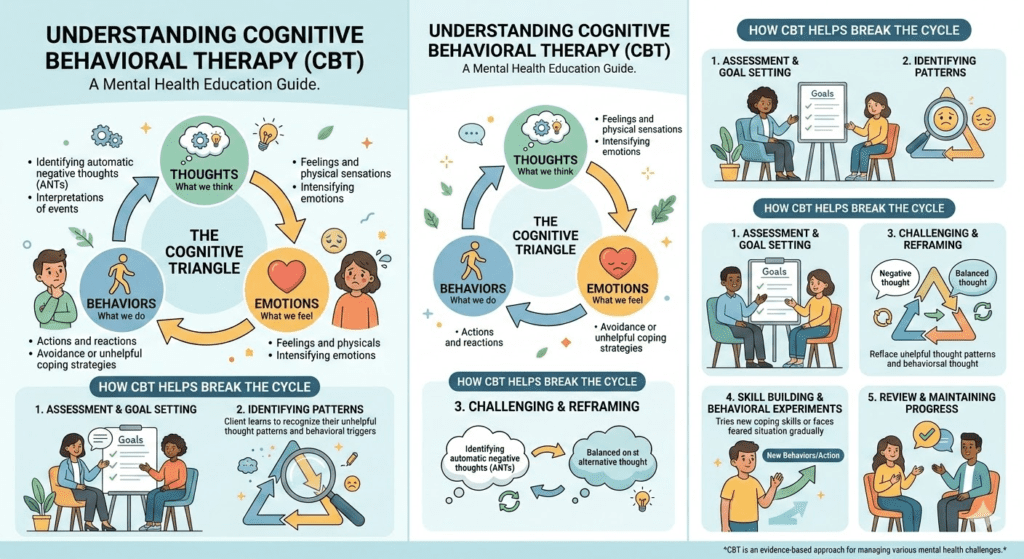
Cognitive Behavioral Therapy (CBT): A Proven Method
One of the most effective approaches for How Therapy Helps in Managing Intrusive Thoughts is Cognitive Behavioral Therapy (CBT).
CBT works by identifying and modifying harmful thinking patterns.
How CBT helps:
- Recognizes distorted thought patterns
- Challenges irrational fears
- Encourages realistic thinking
- Reduces compulsive mental reactions
For example, someone may learn that having a disturbing thought does not mean they will act on it.
Research from the National Institute of Mental Health (NIMH) supports CBT as a highly effective therapy for anxiety and obsessive thinking.
https://www.nimh.nih.gov
Exposure and Response Prevention (ERP) Therapy
Another powerful technique explaining How Therapy Helps in Managing Intrusive Thoughts is Exposure and Response Prevention (ERP) therapy.
ERP is commonly used for obsessive-compulsive disorder (OCD), where intrusive thoughts trigger compulsive behaviors.
ERP works by:
- Gradually exposing individuals to feared thoughts
- Preventing compulsive reactions
- Allowing anxiety to naturally decrease over time
Over repeated sessions, the brain learns that intrusive thoughts are not dangerous.
This reduces the urge to respond with fear or compulsions.
Mindfulness Therapy for Intrusive Thoughts
Mindfulness-based therapies also play an important role in How Therapy Helps in Managing Intrusive Thoughts.
Instead of fighting or suppressing thoughts, mindfulness teaches individuals to observe them without judgment.
Benefits of mindfulness therapy:
- Reduces emotional reactivity
- Improves awareness of thought patterns
- Encourages acceptance rather than resistance
- Helps thoughts pass naturally
Mindfulness meditation has been widely studied and recommended by organizations like Harvard Health Publishing.
https://www.health.harvard.edu
Regular mindfulness practice helps people detach from intrusive thoughts rather than getting trapped in them.
Acceptance and Commitment Therapy (ACT)
Acceptance and Commitment Therapy is another modern approach explaining How Therapy Helps in Managing Intrusive Thoughts.
ACT focuses on accepting unwanted thoughts instead of fighting them.
Key principles include:
- Accepting thoughts without judgment
- Focusing on personal values
- Taking meaningful actions despite mental discomfort
This approach reduces the struggle against intrusive thoughts, making them less powerful over time.
Developing Emotional Coping Skills
Therapy also teaches practical emotional regulation techniques.
These tools help people manage the stress caused by intrusive thoughts.
Common techniques include:
- Deep breathing exercises
- Grounding techniques
- Journaling and emotional reflection
- Stress management strategies
By strengthening emotional resilience, therapy reduces the intensity of intrusive thoughts.
When Should You Seek Therapy?
Understanding How Therapy Helps in Managing Intrusive Thoughts also involves knowing when professional help may be necessary.
Consider therapy if:
- Intrusive thoughts occur frequently
- Thoughts cause anxiety or panic
- They interfere with work, relationships, or sleep
- You engage in repetitive mental rituals or avoidance
Mental health professionals provide safe and structured support to help individuals regain mental clarity.
Benefits of Therapy for Intrusive Thoughts
Learning How Therapy Helps in Managing Intrusive Thoughts highlights several long-term benefits.
These include:
- Reduced anxiety and fear
- Improved emotional control
- Better self-understanding
- Increased confidence in managing thoughts
- Improved overall mental wellbeing
Most importantly, therapy helps people realize that intrusive thoughts are normal mental events that do not define who they are.
Understanding How Therapy Helps in Managing Intrusive Thoughts can transform how individuals approach mental health challenges. Instead of feeling trapped by unwanted thoughts, therapy provides practical strategies to manage them effectively.
Techniques such as cognitive behavioral therapy, mindfulness, exposure therapy, and acceptance-based approaches help individuals change their relationship with intrusive thoughts.
With the right guidance and consistent practice, therapy can significantly reduce distress and help people regain control over their mental wellbeing.
Seeking help from a qualified mental health professional can be the first step toward a calmer and healthier mind.
Also Read: Best Hair Serum for Tangle-Free Hair: 9 Powerful Solutions for Smooth, Frizz-Free Hair
FAQs
1. How therapy helps in managing intrusive thoughts effectively?
Therapy helps by teaching coping strategies, cognitive restructuring, and mindfulness techniques that reduce the emotional impact of intrusive thoughts.
2. What type of therapy is best for intrusive thoughts?
Cognitive Behavioral Therapy (CBT) and Exposure and Response Prevention (ERP) are considered the most effective therapies for intrusive thoughts.
3. Can therapy completely stop intrusive thoughts?
Therapy does not always eliminate intrusive thoughts but helps individuals respond to them in healthier ways so they become less distressing.
4. Are intrusive thoughts a sign of mental illness?
Not always. Many people experience intrusive thoughts occasionally. However, frequent or distressing thoughts may be linked to anxiety or OCD.
5. How long does therapy take to manage intrusive thoughts?
The duration varies, but many people see improvement within a few months of consistent therapy sessions.